
Today we’ll talk about one of the key concepts of search engine optimization.
Relevance is the correspondence between what you were looking for and what you found.
When it comes to pages (websites), this means that the content must match the search query. The more accurately a page answers the query, covers the relevant topic, and solves the user’s problem, the higher (all other things being equal) its position in search results .
Relevance looks different
Let’s say we want to buy an iPhone 11 Pro Max 256GB Gold. The top search results are for online electronics stores. Clicking any of the links on the first search page will show you the phone you need.

Sometimes queries are more ambiguous, and the search engine has to predict which result will be most useful to the user. The results for such queries are less uniform. For example, for the query “accountant,” Google mixes job search sites, Wikipedia, and professional websites.

Another example of a mixed query:

There are some rather unexpected search results. However, they won’t be unexpected for everyone.


From year to year, search engines improve their search algorithms, and the likelihood of irrelevant results appearing on the first pages of search results approaches zero.
How search engines evaluate relevance
The internet offers a huge number of pages that match a given query. Search engines create ranking algorithms to ensure that relevant results occupy the top positions in search results.
Search quality—the ability of a search engine to deliver the desired and expected result to the user—depends on ranking. Ranking formulas are also built automatically, using machine learning, and are constantly being improved.
Relevant content alone isn’t enough to rank high in search results. It’s important that it solves a user’s problem, helps them find solutions, and delivers value. At the same time, search engine crawlers must be able to access the page and understand the content.
Search engine algorithms evaluate hundreds of different factors, from the presence of keywords to the site’s loading speed:
Since Google’s algorithm is constantly improving, don’t try to figure it out and change your site accordingly. Instead, create good, original content that users will love, and follow our recommendations.
SEO specialists suggest that there are more than 200 such ranking factors, and their weight depends on the topic.
Methods for assessing relevance
Objectively assessing the relevance of a particular page or website is more impossible than impossible. Search results are becoming increasingly personalized every day. They depend on the user’s location, search history, device used to search, and many other factors. This means that a website’s position in search results varies not only from day to day, but also from user to user.
It’s a good idea to check whether a page is relevant to a specific query and what position it ranks in search results. This can be done manually or using specialized tools:
1. Manually.
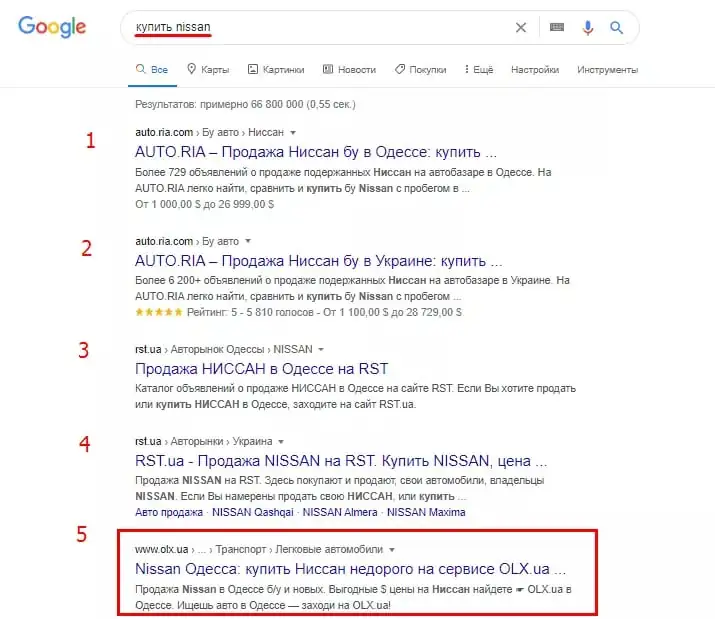
To check whether your site ranks for a keyword, you can search in Google or another search engine. I recommend doing this in Incognito mode to ensure your search history doesn’t affect the results.
In my case, for the keyword “buy Nissan,” the OLX.ua website ranks fifth in the search results.
2. Manually using the site operator site:domain.com.
To determine the most relevant page on a website for a keyword, you can use the search operator site:domain.com.

That is, Google determines the first page in the search results as the most relevant to the keyword “buy a car” on the OLX.ua website.
Without the search operator in the first position, the page is completely different:

3. Netpeak Checker
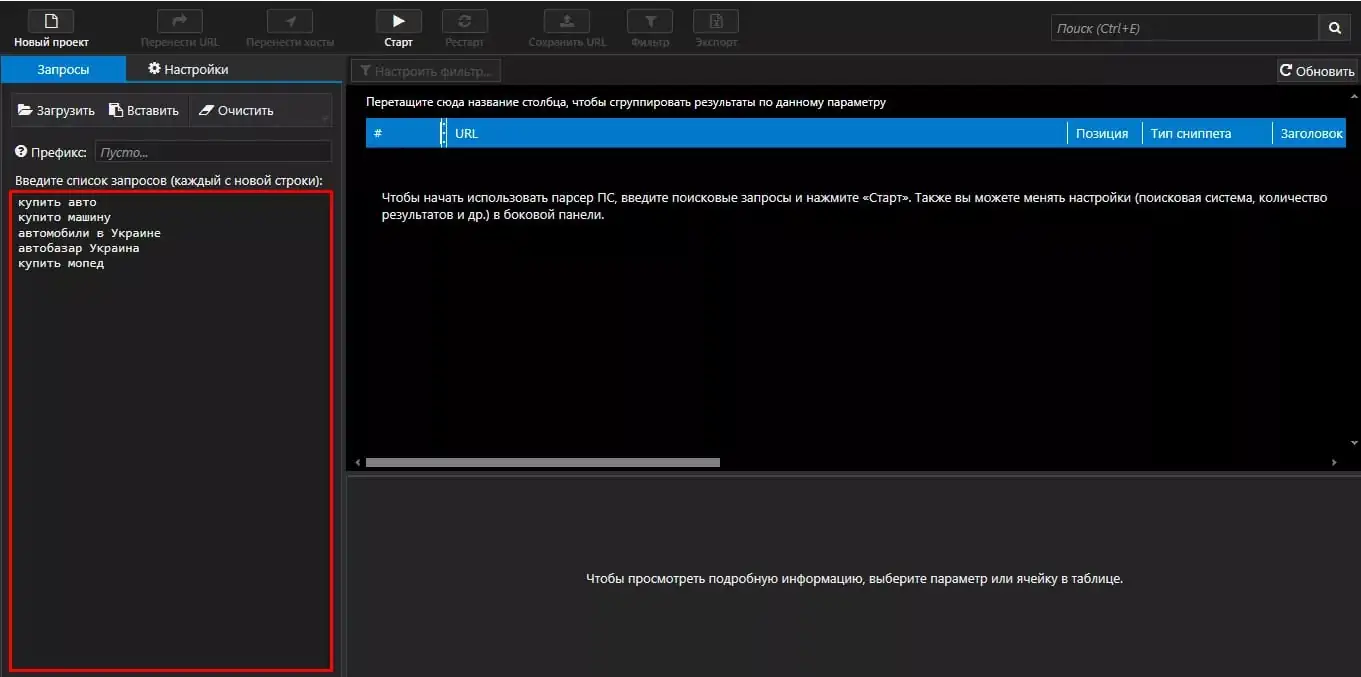
To check a large number of keywords, you can use search results parsing from Netpeak Checker.

In the window on the left side, enter keywords:
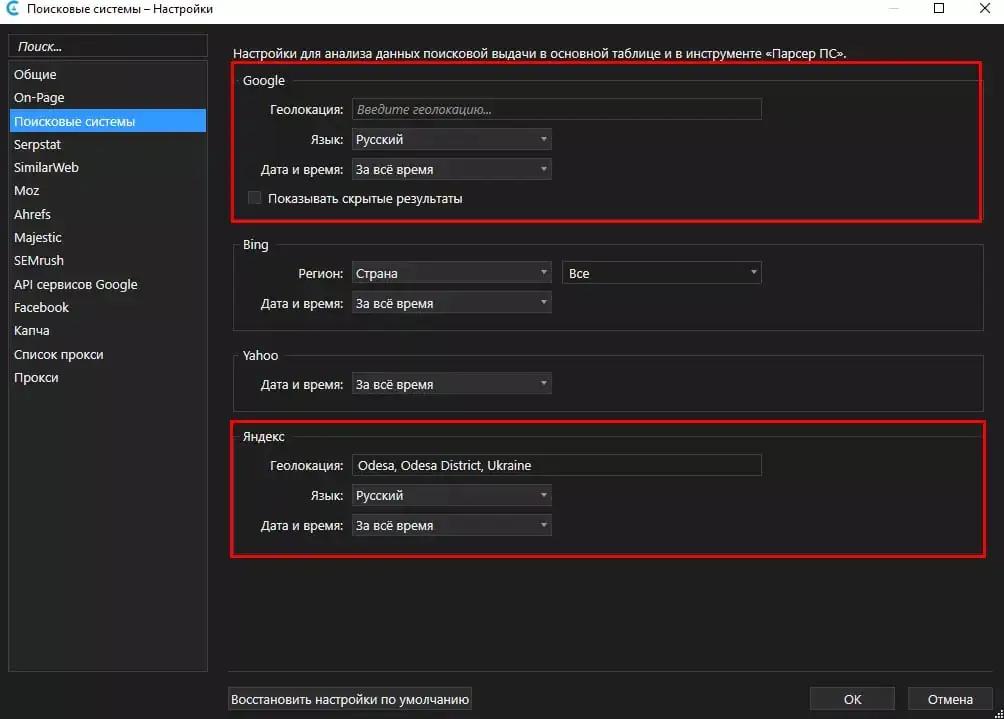
Go to the “Settings” tab:

Select the search engine results to parse, then determine the desired number of results. In the advanced settings, select “Search engines.” Select your geolocation and language.
We obtain the results in the following form:

4. Majento
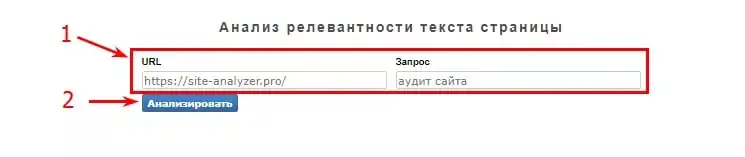
The tool allows you to conduct a detailed analysis of page content for relevance to promoted search queries.
In the appropriate windows, we enter the page address and the keyword we are interested in.

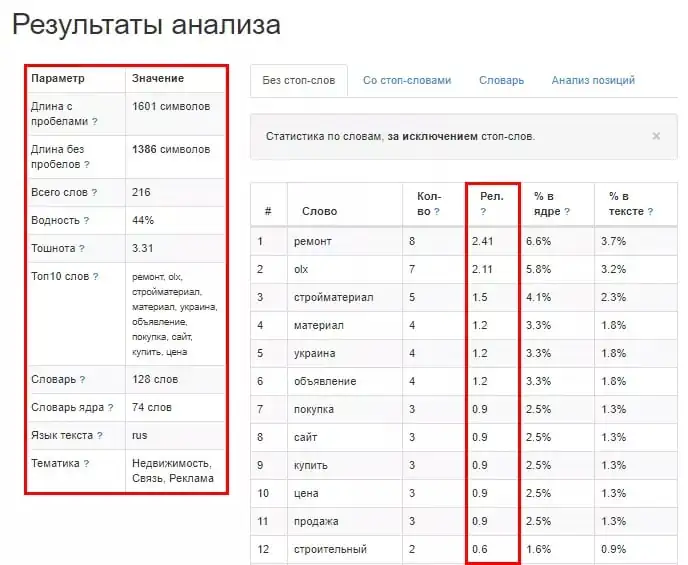
5. Istio
A free online service that analyzes parameters such as text length, word count, relevance, and density.
How to improve the relevance of a page/website
1. Collection of the semantic core and grouping by similar queries.
It’s important to understand how users search for your website. At this stage, we collect keywords using services like Serpstat and Google Ads Keyword Planner . It’s important to collect the semantic core, not just generate it: you’ll be surprised by the phrases people type into the search bar.
2. Optimization of meta tags and headings h1-h6.
Next, using the already compiled core, we create meta tags and headings for the page. Place keywords near the beginning of the title and description.
3. Writing content for the page.
Using keywords as a guide, create useful, unique content for your page. Remember that texts should be written for users, not machines. Don’t try to please search engine crawlers, or you’ll have the opposite effect. After writing, check your text for relevance (uniqueness, keywords, and LSI keywords).
4. Technical characteristics of the site.
Don’t forget about website usability and page loading speed; if these are poor, your content risks going unread.
5. Links
Having links from thematic sites with relevant anchors will help you achieve top positions.
6. Correct website structure
SEO specialists have a rule: “One keyword – one page.”
Each website page should be optimized for one keyword (plus a tail of queries). For each keyword, we create a separate landing page, excluding synonyms.
For example, if a car sales page contains BMW and Audi cars, it will be difficult for the page to rank at the top of the search results for the user’s query “buy a BMW.”
Conclusions
Relevant pages are those that most closely match a user’s query. Search engines are motivated to rank relevant pages as high as possible in search results to be as useful to users as possible.
There are special ranking algorithms that take into account hundreds of different factors, from the presence of unique content to site loading speed.
To get to the top of search results for a keyword, you need to properly optimize your page for that query:
- collect a semantic core;
- optimize page meta tags;
- prepare content that is useful for the user;
- create a correct website structure;
- Work with the link mass and technical characteristics of the site.
Source: Netpeak