When a project owner in an overcrowded niche or a webmaster tasked with bringing a website to the top of a competitive topic hits the ceiling of standard promotion methods, they often turn to lesser-known approaches, including PBNs. We’ve summarized the pros and cons and outlined the steps involved in creating satellite sites.
PBNs (Private Blog Networks) are networks of websites. They are created to generate controlled and relatively free external link traffic for promoting the main website (or individual pages). Domains for PBNs are purchased at auctions or taken from abandoned domains (those whose registrations were not renewed or the site was abandoned for any other reason).
This is a convenient, but risky and expensive way to get links to your resource. A PBN isn’t a panacea and only works in conjunction with other optimization tools. That is, if your website and the product on it are crap, a private blog network won’t help. Or it will help, but only for a short time.
PBN: Pros and Cons
If the site you’re promoting or owning doesn’t need links, you’re already at the top of high-frequency search results—great job, keep it up. If you’re constantly struggling to maintain a high ranking or want to appear in search results with a featured snippet, you’ll likely need a PBN. But this:
Long: searching for a domain with history, checking the history (has the site changed its subject matter, how often, and how far is it from what you need), searching for thematic and closely related sites, checking the site’s link profile, researching to find it in blacklists.
Then, if everything is in order, comes the design creation and implementation (each site in the network should have a different design), and content creation (read: creating technical specifications, finding writers, coordinating/approving texts, uploading content). Oh yes, one article won’t be enough. We start with 5-10. For one site in the network. And you should create at least 10 such sites.
And link weight won’t come right away either; after the link is installed and indexed, you’ll need to wait about 2-3 weeks to receive the donor weight.
Expensive: All of the work described above is not cheap. It’s comparatively inexpensive to hire a team of specialists, where all stages and tasks are evenly distributed among the team members and the work is streamlined. Plus, teams typically have all the necessary tools: paid programs and services for searching and analyzing resources.
The more competitive the topic, the more difficult and expensive it is to buy a domain.
Furthermore, the client’s team must have its own SEO experts (mandatory full-time) who can maintain the network in the future. This is not easy and requires various security measures. For example, accessing each site in the network from a different IP address, ideally not having Google services running on your work computer and/or working in incognito mode, and so on. This also includes the costs of gradually filling these sites with content and optimizing old content.
Stress, a lot of stress: the constant fear that someone (competitors or Google itself) will burn down the network, and you will lose everything at once: PBN, links, and fall under the search engine filters.
With so many arguments against it, is there really any point in building satellites? If a site already uses outreach and buys links on exchanges, then with a well-designed and high-quality network, you’ll get a healthy link pool. This is especially true for overused niches.
This is an effective promotion method for sites and topics where it makes sense/important to promote high-frequency queries and such queries are in the top 30 for your topic.
Furthermore, when properly implemented, a PBN gives you the chance to truly control your website’s link profile. You know for sure that no one will suddenly remove the link, the site won’t be taken down, and you maintain the quality of your resource.
You can also change links to relevant pages on the main site, create cross-links within each site in the network, and, by promoting a particular article from a donor site, increase the link’s weight on the main resource.
In addition, donor sites either fully match your topic, or are relevant to individual pages, closely overlapping in topic or niche.
If you fill each site with unique and useful content and take care of the markup, then creating a unique design for grid sites is not at all essential.
The quality of a PBN link can only change if search engine algorithms change.
To find out if your competitor is using drop domains, use the Serpstat report. It shows domains that fully redirect to the site being analyzed. For each drop, the Domain Rank—an indicator of the site’s authority—is displayed. Using redirect domains, you can more accurately analyze your competitor’s link equity and adjust your strategy.
Important: the full benefits of a private blog network are only possible with a team and resources capable of supporting and developing it. It’s impossible to simply hide the network’s connection to a single owner once and for all. SEOs will have to regularly trick Google.
The more competitive the topic, the more difficult and expensive it is to buy a domain.
Types of PBN
Social network
These PBNs are created on popular blogging platforms (LiveJournal, WordPress.com, Blog.com, Tumblr, and others). They are effective in promoting low-competition niches.
This is a relatively quick and inexpensive way to create a grid. What you need:
- create a website or blog on the desired topic using a free resource (free website builders will help you);
- fill out your profile in detail with believable information;
- collect a semantic core;
- Upload content and add links to the main resource.
Important: all sites on blogging platforms differ in style, design, and sometimes even tone of voice. Naturally, profile information varies, and it can’t be used to link each blog site in the network to a single owner. Links from the content lead not only to the owner’s website but also to other trusted resources. Furthermore, links lead to more than one page of the main site (for example, not just the homepage but also to a blog article or a partner page).
Links are organically integrated into the content.
Remember, content is king. It should be useful articles, reviews, and notes. Links that bring in real, engaged users are valuable.
The downside of this network is that it’s difficult to find a domain with a good history, which means the link’s weight is also questionable.
Recovered PBN
We’re talking about websites restored from the web archive. It’s a real gamble. There’s a risk of landing on a website that’s not indexed, filtered, or blacklisted by search engines.
Niche network of sites
Websites sold by their owners. These are resources related to or relevant to the main website’s topic. They have a good history, and a certain number of their pages are already indexed. These are sites with traffic, meaning they are free of penalties. Such resources have backlinks, meaning links established from them will carry more weight.
All three types of PBN can be used to build external link mass, but the niche network is considered the most effective.
Stages of PBN creation
A domain is the foundation of a PBN, it is important to find a domain that already has a good link mass to transfer to our site.
Expired domains are domains whose registration has expired. You can purchase these domains at the registrar’s price. To find the lowest price, use aggregators.
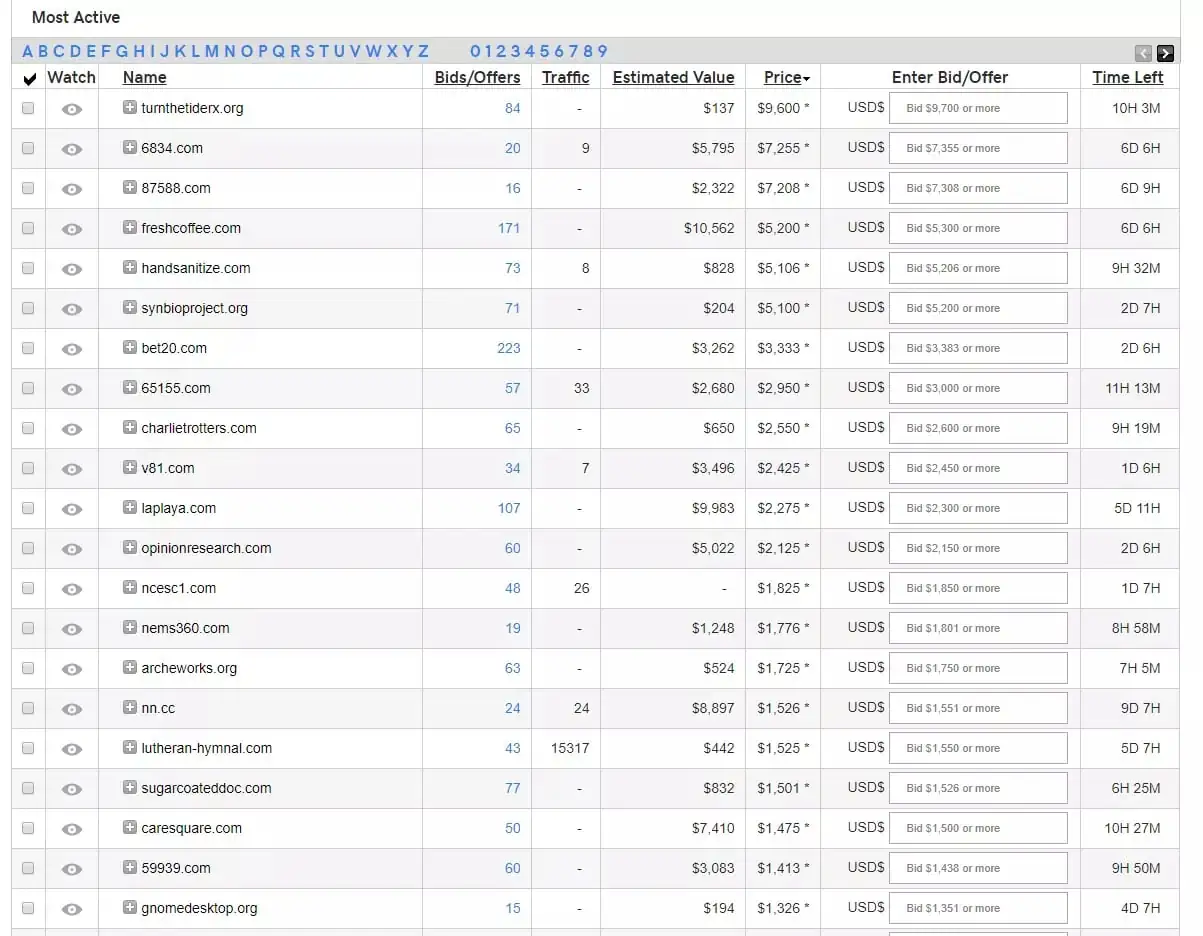
Auction — this stage offers the opportunity to purchase the best domains. The idea is simple: when a domain’s registration expires, all market participants have the opportunity to bid for it in an auction. If the domain isn’t renewed by the current owner and your bid is the highest, you’ll receive it. Domain prices can reach tens of thousands of dollars.
Auctions
Each auction or backorder service has its own list of domains currently up for bidding. You’ll need to download them and check them against your criteria.
Pros
- A good chance to get the best domains at a reasonable price.
Cons
- the approach works only in automated execution;
- high cost of process automation;
- We need APIs for Serpstat, Ahrefs, Majestic, Similarweb, and Moz services.
Where to look for domains
- Ukraine: ukraine domains expired;
- Worldwide: auctions.godaddy; namecheap; namejet.
Services
In this case, you outsource all domain search processes to services. You pay a subscription fee, and the services send you domains with all the required characteristics. You’ll need to check the domain for spam yourself again and place a bid.
Pros
- Convenience: you don’t need to think about how to set up the process from searching to data aggregation;
- updated dashboards;
- Each service has its own perks, for example, domcop.com provides access to a website warser.
Cons
- domains are visible to everyone, both you and your competitors in the niche;
- Services do not always provide all domains that are actually available for purchase;
- Sometimes they give incorrect data about the domain.
Examples
- expireddomains.net;
- domcop.com;
- bluechipbacklinks.com;
- expired.ru;
- spamzilla.io.
Search for expired domains
There are many techniques for searching domains, but in general, the essence comes down to parsing the entire Internet and finding expired domains with the characteristics you need.
Pros
- low cost of domains.
Cons
- time-consuming, low-emission method;
- Need a tool to identify domains for purchase availability?
- We need larger limits on the API services Serpstat, aHrefs, Majestic, Similarweb, Moz.
Contractor services
Here, all the work will be done for you, but still, check what you’re getting. Be sure to check the history ; don’t just take my word for it.
Pros
- You don’t need to figure out how it all works – saving your personal time.
Cons
- you have no control over anything;
- you may be deceived;
- The price is higher due to the contractor’s commission.
We’ve sorted out the domains, what’s next?
Finding content for a site network
Depending on your PBN’s goals, you can fill the site with the necessary content. Content can be anything from text to images, videos, games, products, restaurant menus, data aggregators—basically, anything. So, tailor your PBN to your specific theme. If you have a gaming site, you might want to create a fake game store or a browser game.
You can commission semantically-focused text writing, create a proper website structure, and organize thoughtful interlinking. Spend 200 hours creating 10 websites, and in the end, only the main pages of those websites will be indexed. Yes, there are risks like that.
You can also generate content through articleforge.com or talktotransformer.com and everything will be great, you’ll even get into the top 30.
A basic list of ways to create text content
- search for thematic text in web.archive.org;
- translation of texts from related languages (Ukrainian – Russian, German – English);
- text generation;
- writing texts;
- Get subtitles from YouTube videos/transcribe audio and video content.
Create a website and deploy it on hosting
In short, what needs to be done is to get the site up and running without being caught by a dozen footprints revealing that the sites are interconnected. There are a lot of footprints: contacts, domain owner, IP, name server, site CMS, domain registration date, templates, and identical chunks of code.
There are also many approaches to network hosting.
1. If you don’t have time to manage hosting/servers (or this is just a small test), use specialized services like PBN.HOSTING or Easy Blog Networks. These services create accounts on various registrars.
But there is a very big downside: your neighbors may be the same PBNs, or you don’t control your sites and depend on services.
2. You can upload all your websites to one server and set up proxying, for example, through Cloudflare.
3. A more reliable way to hide footprints is to create dozens of accounts on different hosting providers and host websites there. But you’ll agree that managing and maintaining even 10 hosting providers requires the efforts of a trained person. If you’re unsure, see how it’s done:

Website network management
And most importantly, when building a network, you need to understand who is responsible for what. If you’re building 10 sites, this won’t be a big problem. But if you’re building 50, think about what aspects you need to monitor:
- financial accounting;
- maintaining a register of all projects;
- filling websites and working with them so as not to burn the network;
- team management organization;
- setting KPIs;
- tracking results;
- storing all necessary data;
- analytics.
There are actually a lot of questions—and we’re preparing an article on how to organize PBN construction management. If you don’t have time to wait and figure out how to build a PBN and dramatically boost your website’s link profile, contact our specialists.
Source: Netpeak.net