
Promotion, development, and increasing website visibility in search engines—it’s all about SEO. However, experience working with small businesses and entrepreneurs just getting started online shows that people have a poor understanding of what SEO is and why it’s important.
SEO (Search Engine Optimization) is a set of measures and actions that eliminate, prevent, and minimize technical errors on a website and improve its readability by search engine robots. The essence of SEO is to make it faster and easier for users to find the information they need and to ensure that this information accurately matches what they searched for on Google, Yandex, Bing, Yahoo, and other search engines.
The job of SEO specialists is to optimize a website and gain the trust of search engines, which will help your target audience find your website, product, service, or content and perform the desired action. This means buying, ordering, subscribing, and becoming your loyal customer, subscriber, or reader.
What, how and where do users search?
When people search online, they enter keywords (search queries) that are most likely to answer their question. For example, to find the definition of “SEO,” users enter search queries such as ” what is SEO? “, “what is SEO optimization ?”, “what is search engine optimization,” and others.
Each of these may have its own list of results. After entering a query and clicking the “Search”/”Find” button, a numbered list of 10-15 sites appears on each page (search results). Sites may occupy a certain position (ranked in a certain order) depending on a variety of factors.
Experience shows that users rarely go beyond the second page of search results. Therefore, to attract more users to a website, it must reach the top (the list of sorted pages that a search engine returns for a given query). The higher a website ranks in search results, the more likely it is that a user will click on it.
Search results blocks
When you enter a query into the search bar, you can see not only a list of sites in specific positions but also blocks of information without any number. For example, if you search for “what is SEO,” you’ll see a block on the right with a definition and several infographics, followed by some sites categorized by position below, and a little further down is a block with “related queries.”
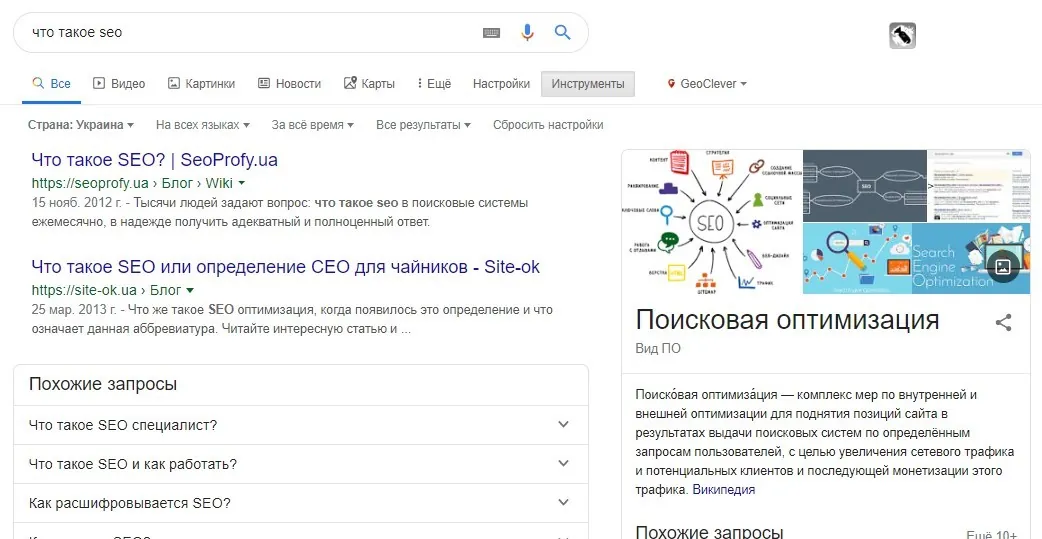
What search results blocks are there besides the top ones? The main ones include:
- similar queries;
- rich snippet;
- block of exact answers;
- carousel;
- contextual advertising blocks;
- knowledge graph.
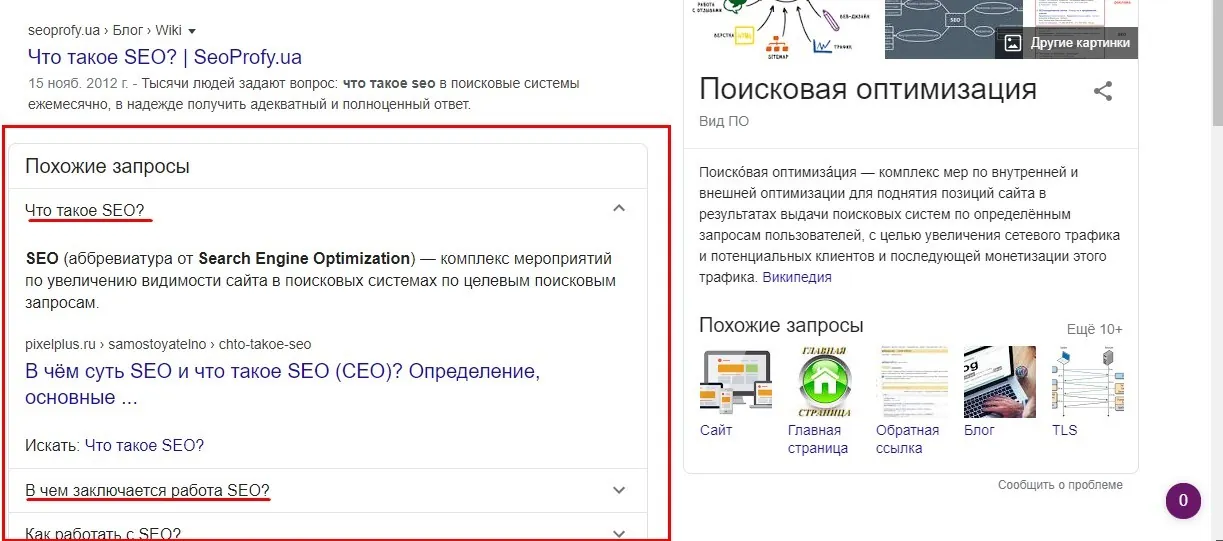
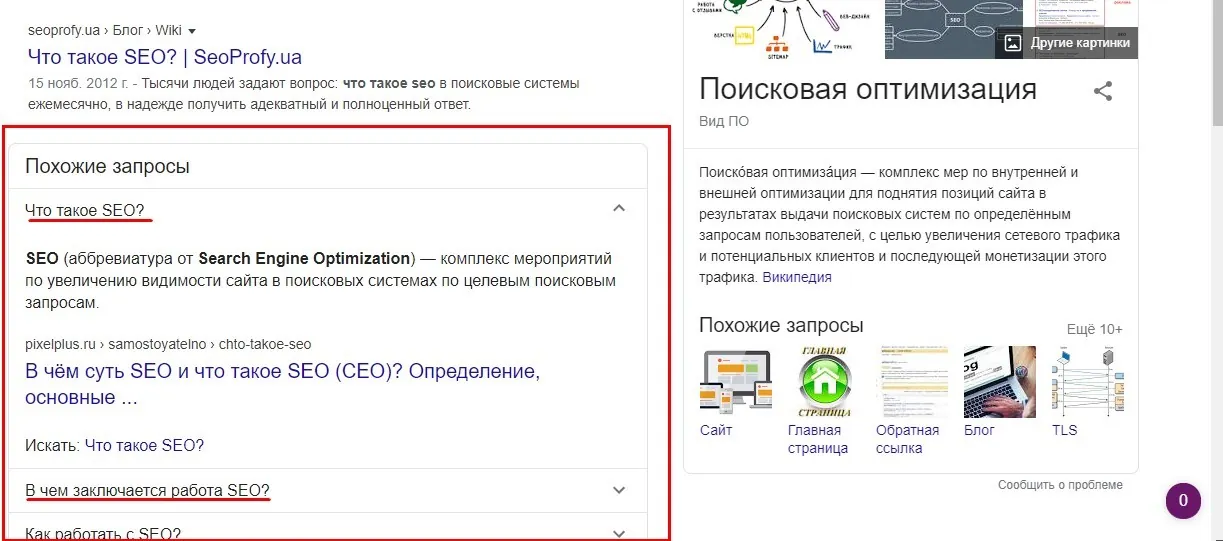
Such answer blocks can be called “position zero” because they don’t have a number in the search results. For example, a “related queries” block with a drop-down list of questions and short answers:
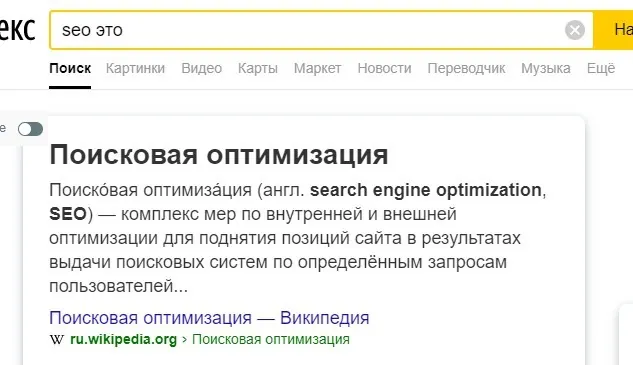
Search results block variant with definition:
In response to queries like “how to do something,” “steps,” or a recipe for something, the search returns a block with lists:
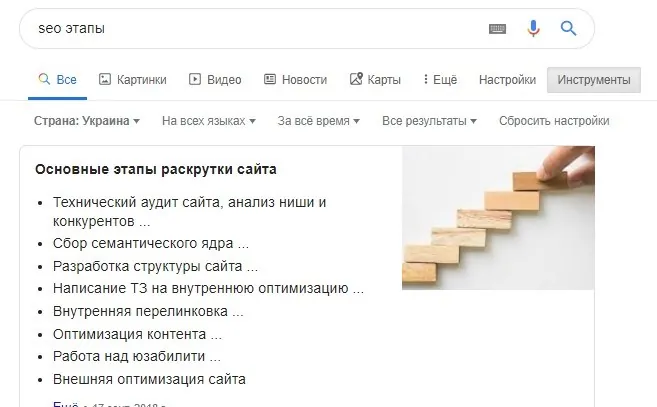
These are informational blocks in the search results and are typically displayed as lists, tables, paragraphs, or videos. Informational blocks, including the top positions and the zero position, can be influenced by SEO, while others cannot. Examples of other blocks:
- Quick answer blocks. For example, “How old is Bill Gates?”

- The Carousel block can contain photos of actors, the most suitable products, brands, and more.

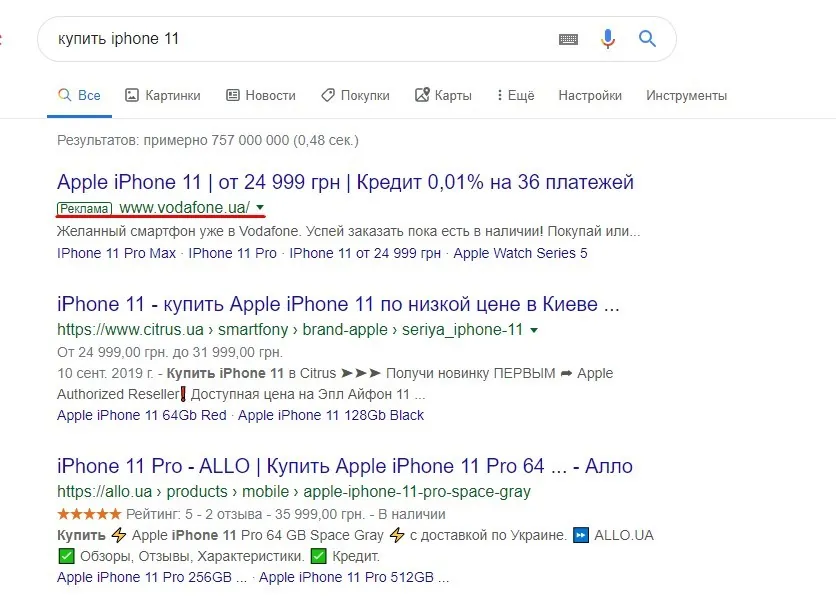
- Contextual advertising units are ads that are displayed to the user based on their search query. This unit appears above all other positions, to the side, or below the numbered search results.
- A knowledge graph is a block with a precise and broad answer to a given query about an object or person.

Search engines always strive to best satisfy user queries, which means they rank websites in order of decreasing relevance and potential usefulness to the user. So how do search engines work?
Search engine work
For a website to appear in search results , it must go through three stages: crawling, indexing, and ranking. Search robots, or crawlers, check websites for their page content, the relevance of the information, its accuracy, and so on.
- During the crawling phase, robots crawl the site and find new pages by following the links they discover. The crawler can either discover new pages itself or be directed to them manually, for example, through webmaster tools (Google Search Console, Yandex.Webmaster).
- During the indexing stage, the robot determines the page’s nature and examines its subject matter and content. It can then add it to its database, its own index, if it deems the page’s content useful for users.
- At the final stage, the robot selects the most relevant pages from its own index and returns them in response to a specific query. The order of results depends on how well the robot determines the content (its quality, domain reputation, etc.) meets the user’s expectations.

An SEO specialist’s job is to improve a website so that search engines will find its content useful, index it, and rank it as high as possible in search results. There are various website optimization methods for this.
Optimization methods
Search engines were primitive in their early days, and it was easy to get a website to the top through dishonest means. For example, by stuffing a page with a huge number of keywords or by mass-submitting the site to various directories and catalogs.
Search engines have improved, and old methods no longer work (or barely work, or produce results for a short period of time, after which the site is filtered). Because search engines are constantly evolving their algorithms and introducing new rules, SEO optimization has become divided into white hat, gray hat, and black hat methods.
White hat website optimization techniques
White hat optimization methods (natural methods) are methods that are “allowed” for website promotion and do not violate search engine rules.
For white hat methods, there is internal and external optimization.
Internal optimization
On-page optimization begins with niche analysis. It’s important to identify competitors, analyze them, and understand what needs to be done to fully capture the website’s theme and provide the most comprehensive information possible to user queries in that niche. Each theme requires its own promotion strategy. You need to know which pages should be optimized, how to manage link building, and so on.
One of the most important steps in optimization is creating a semantic core. This involves selecting keywords that will be used to optimize the website. A properly created semantic core, broken down into categories and filters, helps you understand how to:
- work with the structure – expand or remove pages, menu items/categories, generate page URLs;
- Optimize tags and meta tags – adding certain “markers” to pages that show the user and search engine robot what is there;
- add text content to pages.
When working with internal optimization, the technical side of the work is also important—checking the site’s functionality and the relevance of its content. For example:
- Checking the functionality of the website navigation – checking the functionality of all buttons, forms, and interactive elements on the website;
- search for duplicate pages and broken links – drawing up technical specifications for their elimination;
- Loading speed check – the user will not have to wait if your site takes too long to load;
- Correct indexing – it is important to ensure that pages such as the shopping cart, search, sorting pages, and others are not included in search results.
It’s essential to check your website’s performance monthly, identify any errors, and ensure everything meets search engine requirements. This helps you quickly identify issues that affect your website’s ranking.
External optimization
External optimization – working on mentions of the website/brand in other sources, working with reputation, reviews, and incoming links.
Incoming links are links that point to your website from other resources. The aggregate of these links is called a link pool . Ideally, link pool should grow naturally. To achieve this, you need to create high-quality content, engage users, and create newsworthy content so that users will naturally share your articles, videos, promotions, and discounts.
If a site’s link mass is not growing compared to competitors, various artificial link building methods are used.
Important : Often, improper link building (suddenly creating a large number of links to a site, using spam methods, or links from low-quality sites) can result in penalties from search engines. This type of link building is more akin to “gray” or “black hat” promotion methods.
Black/gray optimization methods
Using gray and black hat optimization can help you reach the top faster, but it also increases the risk of penalties (measures for violating rules) from search engines—a demotion in search results, a complete ban, or exclusion from the index in the future.
The greater the violation of search engine rules during optimization, the more nefarious the methods used.
Black hat methods are dishonest and prohibited by search engines methods of website promotion.
Examples of black hat optimization techniques:
- written text with keyword spam;
- links from doorway pages – sites aimed solely at advertising;
- various spam aimed at attracting traffic;
- cloaking – when a user sees one thing (for example, good text), and for a search engine another is created with keyword spam;
- links on invisible small images (1×1 size) or on punctuation marks;
- purchasing temporary links that will be deleted over time or links from low-quality sites (automatic and bulk link purchasing).
Important : Search engines almost always and very quickly recognize black hat optimization methods, so you shouldn’t use them if you don’t want to be filtered and penalized.
Gray hat methods are those that haven’t been banned by search engines, but aren’t approved by them either. White hat methods are often used for on-page optimization, while off-page optimization may employ some gray hat methods (for example, using exchanges for permanent links or registering in directories).
Advantages and Disadvantages of SEO
We won’t discuss whether SEO is necessary or not. Website optimization is definitely necessary. But there are some specific aspects of online promotion that you need to be aware of to stay grounded in reality: business owners sometimes either place too much hope in SEO (and, consequently, in SEO specialists) or simply don’t believe in this tool. So, let’s talk about the benefits :
- Profitability .
Attracted traffic is users who entered a relevant keyword and landed on the site via search. These are people ready to take a targeted action (e.g., make a purchase). Therefore, by increasing a site’s visibility in search, SEO increases its revenue.
- Long-term effect .
The optimization effect lasts for a long time (compared to working on contextual optimization). After working on a particular category, the site will rank high in search results (for specific queries). This means the page has been liked by search engines and will rank well until (unless) search engine requirements or rules change.
- Trusting relationship with the client.
Users may distrust advertisements and be more likely to visit websites that are at the top of search results.
Furthermore, the process of internal optimization makes the website more user-friendly, which leaves a positive impression and encourages users to return to the site, make another purchase, and recommend it to friends and acquaintances.
Flaws:
- Long lead times and results.
Unlike contextual advertising, don’t expect quick results from SEO. Search engine optimization does produce results, but it’s a long-distance sprint.
- No guarantees.
No specialist can give you a 100% guarantee of SEO success. After all, search engine requirements can change at some point and negatively impact even a well-optimized website. For example, over time, it became necessary to focus on a mobile version of a website—as mobile traffic increased, search engine algorithms changed.
- The need for complex technical modifications.
A truly significant number of improvements to the site and their timely implementation are required to achieve the stated goals.
Conclusions
- SEO (Search Engine Optimization) is a set of measures and actions that eliminate, prevent, and minimize technical errors on a website and improve the readability of the resource by search engine robots.
- By entering a query into the search bar, you can see not only a list of sites in specific positions but also information blocks without any number. The following search results blocks exist:
- similar queries;
- rich snippet;
- block of exact answers;
- carousel;
- contextual advertising blocks;
- knowledge graph.
- For a website to be included in search results, it must go through three stages: crawling, indexing, and ranking.
- An SEO specialist’s job is to improve a website so that search engines find its content useful, index it, and rank it as high as possible in search results. There are various website optimization methods for this purpose. SEO optimization is conventionally divided into white hat (external and internal), gray hat, and black hat methods.
- SEO has its benefits:
- profitability;
- long-term effect;
- helps build trusting relationships with the client.
But there are also disadvantages:
- long lead times and results;
- lack of guarantees;
- the need for complex technical modifications.
Source: Neatpeak Journal